docs
Sea-Bird CTD - Introduction and context
General context, architecture, and measurement chain of a Sea-Bird 911+ CTD.
Introduction
During oceanographic cruises, vertical profiles are carried out at regular intervals with a CTD-O2 probe, for Conductivity-Temperature-Depth-Oxygen. This instrument measures ocean temperature, salinity, and dissolved oxygen with very high precision along the water column through pressure measurement.
The CTD most commonly used in many laboratories is a Sea-Bird SBE 911plus V2 system. It is equipped as standard with the following sensors:
- a Digiquartz® pressure sensor developed by Paroscientific Inc. It includes an internal temperature sensor to correct the pressure measurement for temperature. It can measure from 0 to 10,000 psi (
pound per square inch, absolute), or 6,800 dbars, with 1 dbar = 1.4503774 psia, a resolution of 0.001% of full scale (0.068 dbar), and an accuracy of 0.015% of full scale (about 1 dbar). - two platinum temperature sensors, measuring between -5 °C and +35 °C, with a resolution of 0.0002 °C and an accuracy of 0.002 °C.
- two conductivity sensors with electrodes placed in a glass tube, measuring absolute conductivity. The measurement range is 0 to 7 S/m (Siemens per meter, equivalent to 0-70 mho/cm), with a resolution of 4.10-5 S/m and an accuracy of 0.0003 S/m.
- two dissolved oxygen sensors, with polarographic membranes, measuring in a range from 0 to 120% saturation with an accuracy of 2% over the measurement range.
- two external pumps connect each T/C and O2 sensor set, ensuring better synchronization of their dynamic responses. Likewise, each temperature sensor is connected to the conductivity sensor by a duct (TC duct), so that both sensors measure exactly the same water. Since the temperature sensor has a response time of 70 ms, seawater passing through the TC duct takes exactly 70 ms before being measured by the conductivity sensor, whose response is instantaneous.
This architecture largely explains the quality of the measurements, but also the complexity of diagnostics when the chain no longer works correctly.
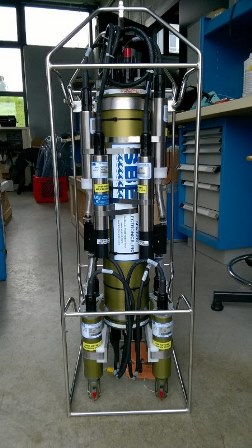
View of a horizontally mounted Sea-Bird CTD on its frame, a typical configuration for interventions and checks.
The probe is usually installed horizontally on a frame incorporating a rosette or carousel for water sampling at different depths. Additional sensors can also be mounted on the CTD or on the rosette, for example:
- a Wetlabs ECO-FL fluorometer for chlorophyll measurement.
- a Wetlabs C-Star transmissometer.
- a light sensor (PAR).
- an altimeter to measure the distance between the CTD and the seabed.
- two LADCPs (Doppler current meters) for measuring current along the vertical profile.
Samples are taken during the upcast, then analyzed on board or in the laboratory. The entire measurement system, usually described in English as a CTD rosette or CTD package, is connected to the ship by an electro-mechanical sea cable deployed with a dedicated electric winch.
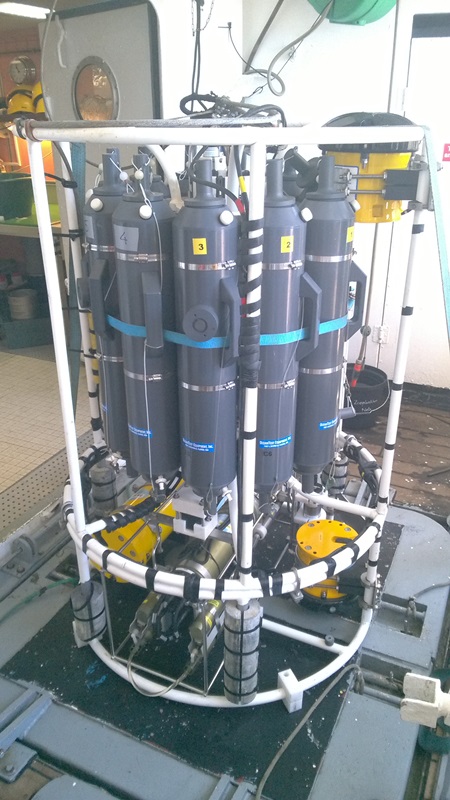
Sea-Bird CTD and sampling rosette on the R/V Antéa.
The SBE11 deck unit powers the CTD package and retrieves real-time data through the electro-mechanical sea cable, slip ring, and acquisition computer. The Seasave acquisition software supplied by Sea-Bird then converts the frequencies and voltages from the sensors into physical quantities.
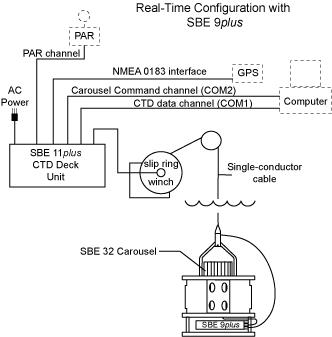
Schematic diagram of a real-time CTD package.
The measurement system therefore includes three main subsystems:
- the power supply chain
- the CTD rosette itself
- the acquisition chain
Many of these elements operate in seawater, a hostile environment by definition. When a malfunction occurs, it is therefore not always easy to determine the origin of the problem. The goal of this guide is to make fault diagnosis easier using concrete cases, simple checks, and shared experience.
Back to documentation | Back to summary | Next: Test cable and connection